top of page

Research Blog

Buscar
  • Foto del escritor: Carlos Osorio
    Carlos Osorio
  • 18 abr 2023
  • 2 min de lectura

Actualizado: 6 nov 2024

Phase retrieval is an important problem in many fields, including image processing, optics, and computer vision. It refers to the process of recovering the phase of a signal from its magnitude. In recent years, deep learning has emerged as a powerful tool for image processing tasks, including phase retrieval. In this article, we will explore the concept of phase retrieval in image processing and discuss the use of untrained deep learning models for phase retrieval.


Phase Retrieval in Image Processing


In image processing, phase retrieval refers to the process of reconstructing an image from its magnitude. The magnitude of an image is the absolute value of its Fourier transform, while the phase is the angle of the Fourier transform. Phase retrieval is necessary in many applications where only the magnitude of the image can be measured. For example, in X-ray crystallography, the intensity of the X-ray diffraction pattern can be measured, but the phase information is lost. Similarly, in microscopy, the phase information of an image is often lost due to the use of lenses. Phase retrieval can be approached using various algorithms, including the Gerchberg-Saxton algorithm, the Fienup algorithm, and the alternating projection algorithm. These algorithms typically require prior knowledge of the phase or some initial estimate of the phase. However, in some cases, this prior knowledge may not be available or may be inaccurate, making the phase retrieval problem challenging.


Untrained Deep Learning for Phase Retrieval


Deep learning has been successfully applied to various image processing tasks, including image restoration, denoising, and segmentation. Recently, deep learning has also been applied to phase retrieval. One approach is to use untrained deep learning models for phase retrieval. These models are trained on a large dataset of random phase images and their magnitudes. During inference, the model is presented with the magnitude of an image and is expected to output the phase. The use of untrained deep learning models for phase retrieval has several advantages. First, it eliminates the need for prior knowledge of the phase or some initial estimate of the phase. Second, it can handle noise and other distortions in the input magnitude. Third, it can be trained on a large dataset of random phase images, making it applicable to a wide range of problems. One popular untrained deep learning model for phase retrieval is the U-Net. The U-Net is a convolutional neural network that has been widely used for image segmentation tasks. However, it can also be used for phase retrieval by treating the magnitude of an image as the input and the phase as the output. The U-Net architecture consists of a contracting path, which encodes the input image into a latent space, and an expanding path, which decodes the latent space into the output phase.


Phase retrieval is an important problem in image processing, and deep learning has emerged as a powerful tool for addressing this problem. Untrained deep learning models, such as the U-Net, have been shown to be effective for phase retrieval, eliminating the need for prior knowledge of the phase or some initial estimate of the phase. The use of untrained deep learning models for phase retrieval has the potential to revolutionize the field of image processing, making it applicable to a wide range of problems.


  • Foto del escritor: Carlos Osorio
    Carlos Osorio
  • 3 abr 2023
  • 1 min de lectura

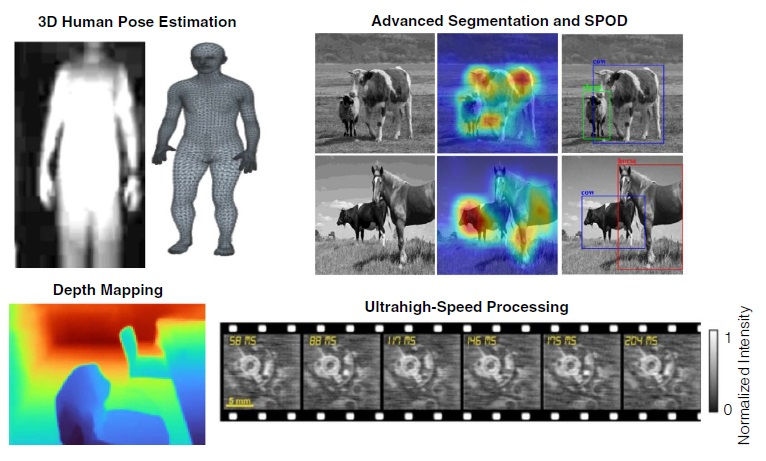
SMPLX Human is a cutting-edge human model generated using single-pixel imaging technology. This model represents a significant leap forward in the field of computer graphics and machine learning, as it allows for the creation of highly realistic and accurate 3D models of human subjects. Single-pixel imaging is a technique that involves using a single light source and a detector to capture information about an object's appearance. This information is then processed using algorithms to generate a 3D model of the object. The SMPLX Human model takes this process one step further by applying machine learning to the data obtained from single-pixel imaging.


To generate the SMPLX Human model, researchers first captured single-pixel images of a diverse range of human subjects. These images were then processed using machine learning algorithms to extract detailed information about the subjects' bodies, including their body shape, pose, and clothing. This information was then used to generate highly realistic 3D models of each subject.

The SMPLX Human model is highly versatile and can be used for a wide range of applications, including virtual reality, computer graphics, and robotics. Its high level of accuracy and realism makes it an invaluable tool for industries such as film and gaming, where lifelike human characters are in high demand.


The generation of the SMPLX Human model using single-pixel imaging technology and machine learning algorithms represents a significant advancement in the field of computer graphics and machine learning. Its highly accurate and realistic 3D models of human subjects have numerous applications and are sure to have a significant impact on a wide range of industries in the years to come.


  • Foto del escritor: Carlos Osorio
    Carlos Osorio
  • 2 mar 2023
  • 2 min de lectura


Segmentation and kinematic analysis are critical techniques for applications in surveillance, as they enable us to analyze and extract meaningful information from video data. In recent years, the use of deep learning techniques, particularly those implemented using the PyTorch GPU pipeline, has significantly improved the accuracy and efficiency of these techniques.


Segmentation involves the separation of objects or regions of interest in an image or video frame. It is a key step in many surveillance applications, such as object tracking, object recognition, and activity recognition. PyTorch provides powerful tools for implementing segmentation models, such as the popular Mask R-CNN and U-Net architectures. These models leverage the power of convolutional neural networks (CNNs) to extract features from image data, which are then used to generate segmentation masks that separate the regions of interest from the background.

Kinematic analysis, on the other hand, involves the extraction of motion-related information from video data. This includes tracking the movement of objects or people, estimating their velocity, and analyzing their trajectories. PyTorch can be used to implement kinematic analysis models that are capable of processing large amounts of video data in real-time. For example, the YOLO (You Only Look Once) and Faster R-CNN models are popular choices for object tracking and detection in surveillance applications.


Implementing segmentation and kinematic analysis models using PyTorch's GPU pipeline can significantly improve the speed and accuracy of these techniques. GPUs are designed to perform complex mathematical operations in parallel, which makes them well-suited for deep learning tasks. PyTorch's GPU pipeline allows us to take advantage of this parallelism by offloading the computation to the GPU, which can process the data much faster than a CPU.


PyTorch's GPU pipeline is an excellent tool for implementing segmentation and kinematic analysis models for surveillance applications. These techniques can help us extract valuable insights from video data, such as identifying and tracking suspicious individuals or objects, and can be used to enhance the overall security of a given area.


bottom of page